
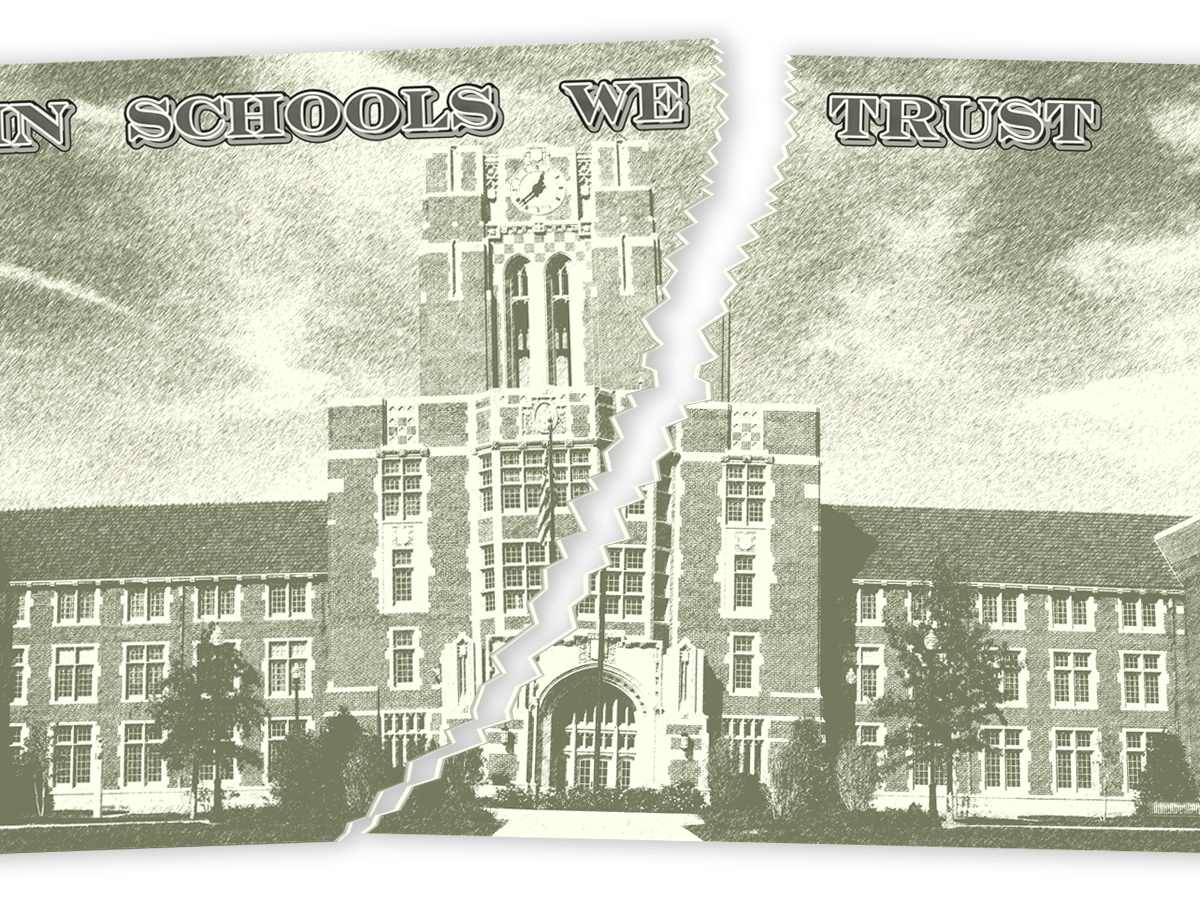
The Consequences of Shattered Trust
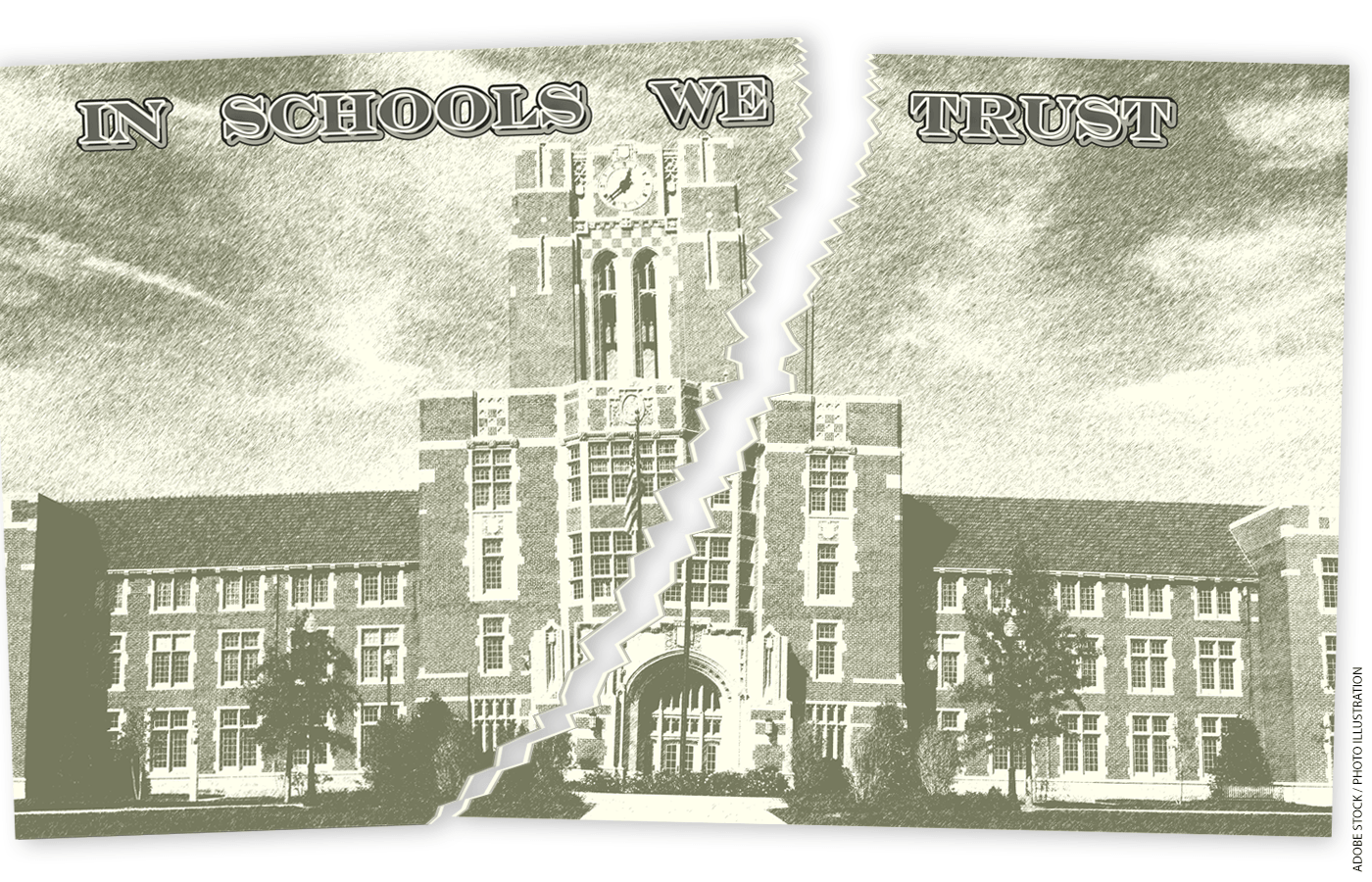
Education has experienced a series of discombobulating swings in recent years. Even savvy observers have struggled to make sense of them all. Why has school choice enjoyed such explosive growth? Why did the culture wars erupt with such a vengeance? How did colleges wind up in the crosshairs? Given dismal student performance, why isn’t there more appetite for K–12 accountability?
There are specific answers in each case. But there’s also a cheat code that helps explain the broader trend and offers some insight as to where things are headed.
For a very long time, schools and colleges were among the nation’s most trusted institutions. Today, though, they’ve been swamped by a sea change in public opinion.
In 1973, 61 percent of Republicans and 60 percent of Democrats said they had “a great deal” or “quite a lot” of confidence in America’s public schools. By 2022, that was down to 43 percent among Democrats and 14 percent among Republicans. While public schools enjoyed overall support from 58 percent in 1973, that had fallen to 28 percent by 2022.
In higher ed, with a condensed timeline, the collapse has been faster and more dramatic. In 2010, 75 percent of Americans said college was “very important.” In 2025, just 35 percent did. In 2015, Gallup first asked about confidence in higher education (tellingly, it hadn’t previously bothered to ask). That year, 57 percent of respondents said they were confident in higher education. By 2024, that figure was down to 36 percent.
What’s driven the shift? It’s a product of declining trust in institutions across the board. This was accelerated by the twinned rise of populism and divisive DEI-imbued ideologies. And the final straw may have been school systems throwing in the towel during Covid while elite colleges became synonymous in the public mind (fairly or no) with antisemitism and onerous debt.
Through the late 20th century and the first years of this one, policymakers and the public mostly treated colleges with deference and the internal workings of schools with benign neglect. As much as educators decried the “intrusiveness” of No Child Left Behind or Obama-era teacher evaluation, neither initiative made much effort to influence school-level decisions around books, instructional materials, grading, curricula, staffing, or how to teach civics or history. Even “reformers” hesitated to insert themselves too deeply into the day-to-day work of schools or colleges. But the pandemic, populism, and the platforming of “anti-racist education” combined to upend this hands-off approach.
The consequences of broken trust have hit education especially hard in for at least three reasons.
First, educational institutions have a formative mission. To my mind, that’s inevitable and appropriate. They’ve historically been tasked with helping to inform their students’ views and values. But as trust in them declines, schools and colleges will face more scrutiny from those concerned about which values are being promoted, who’s making those decisions, and how that’s working in practice. Whatever role one thinks schools ought to play, declining trust complicates their efforts.
Second, schools and colleges depend heavily on public dollars. A loss in trust means new questions arise about what taxpayers are getting in exchange for the vast sums they’re providing. When K–12 schools spend close to $20,000 a year per pupil and the public underwrites hundreds of billions in nonperforming college loans, trust becomes a pocketbook issue.
Third, educational institutions have tended to take their autonomy for granted. The independence of higher ed is viewed as a birthright that helps safeguard academic freedom. In K–12, the long leash is a product of early 20th-century reforms that insulated schools from politics. The result was a culture where institutional leaders at both levels were ill-prepared for populist backlash.
Given all this, plunging trust has had big implications for policy and practice.
Take school choice. From 1990 to 2020, choice advocates spent decades grinding out stop-and-start wins. Then, in the wake of Covid school closures and clashes over gender identity and DEI, there was a metamorphosis. In these moments of crisis, many public school parents just weren’t that worried about whether private alternatives would yield better test scores. What mattered more to many was, “Why aren’t our kids back in school?” and, “What are their schools teaching them?” When parents and policymakers lose their default confidence in public schools to navigate fraught decisions (around books, sexuality, history, et al.), the sheer number of potential pain points means the case for choice will snowball.
Why have advocates for K–12 accountability had such a tough slog? After all, you might think distrust would be a boon for testing—a good way to keep a wary eye on schools. The wrinkle? No Child Left Behind, the Common Core, and the schism between populists and institutionalists marked accountability hawks as part of the education establishment. Rather than being labeled as suspicious outsiders seeking to get schools back in line, they got coded as elite regulators committed to the status quo. The future of testing may well depend on their ability to rewrite that narrative.
Why have concerns about grade inflation become more prominent of late, when it’s been going on for decades with little obvious consternation? When faith in good intentions erodes, stubborn problems like grade inflation morph into evidence of an intent to deceive parents and defraud students. That means schools and colleges can no longer be trusted to police themselves. On the left, this distrust manifests in the push for “equitable grading,” which ostensibly combats the systemic biases baked into teaching. On the right, it shows up in the Trump Higher Ed Compact’s grading directive, which requires schools to adopt measures like grade distribution dashboards. Either way, it results in a demand for new strictures on how schools or colleges go about their day-to-day work.
Subscribe to Old School with Rick Hess
Get the latest from Rick, delivered straight to your inbox.
The struggle of a bipartisan, broad-based coalition to rile up parents about chronic absenteeism may also be attributed to lost trust. Emphatic pleas to address absenteeism from the same school leaders who prolonged Covid-era shutdowns are frequently greeted with jaded missives along the lines of, “Oh, NOW you care about getting kids into school?” and “Who are you to second-guess parents, given all the days devoted to teacher work days and testing?”
In higher ed, the consequences of lost trust may be even starker. Twenty years ago, even at the height of the Spellings Commission on Higher Education, one couldn’t have imagined the kind of intensive federal investigations into elite universities that have now become commonplace. Once upon a time, proposed cuts to university research funding would have encountered a buzz saw of bipartisan opposition; now, not so much on the right. And while Democratic officials still evince affection for elite higher ed, younger Democrats are perfectly willing to denounce colleges for being too expensive and too tied to the establishment.
During the Clinton-Bush-Obama years, higher ed policy often seemed to consist of a search for ways to expand student lending. As trust fractured, though, college costs came under scrutiny. This ultimately yielded the Biden student loan forgiveness push, which implicitly presumed that college was a rip-off. Meanwhile, Republicans who’d spent the Obama years warning against federal micromanagement of higher ed are now mostly fine with it. That’s why the big reconciliation bill Republicans passed last summer imposed bold new limits on college borrowing. The old bipartisan enthusiasm for lending has morphed into shared skepticism of what those dollars are buying.
Look, are some of these impulses contradictory? Sure. People aren’t always consistent. Political coalitions have their own logic. And there are plenty of feelings at work besides trust. But losing one’s trust has major, lasting consequences.
Ultimately, a big part of “education reform” over the next several years is going to turn on how effectively K–12 and higher education can win back public trust. College leaders are adopting institutional neutrality and talking about ways to address grade inflation, but they are finding it far tougher to embrace the kind of belt-tightening that would address concerns about costs and eye-popping sticker prices. In K–12, public school reformers tout career pathways and a new commitment to literacy while hoping the passage of time dims memories of the excesses of the DEI era. Will this be enough to turn things around? We shall see. As any teacher will tell you, rebuilding trust, once broken, is no easy task.
Frederick Hess is an executive editor of Education Next and the author of the blog “Old School with Rick Hess.”
The post The Consequences of Shattered Trust appeared first on Education Next.
Source: EducationNext
Please Follow Us:


Please Share:
