

How Democrats Lost the Plot on Schools—and How to Get It Back

The good news is that Democrats are finally admitting what parents, advocates, and researchers have known for years: The party doesn’t have a credible, student-centered education agenda. The bad news is how long it took to get here and the absence of a clear plan for turning the situation around.
Former Chicago mayor—and possible 2028 presidential contender—Rahm Emanuel has been saying this out loud longer and louder than almost anyone. He’s been joined by center-left voices like Jonathan Chait, Matthew Yglesias, Nicholas Kristof, and even by critics on the center-right. David Brooks bluntly asked in The New York Times, “Why are Democrats increasing inequality?”
That chorus is joined from within the education sector. On the center-right, Mike Petrilli has convened a cross-ideological debate under the provocative question: “Is blue state ed reform hopeless?” On the center-left, Jorge Elorza and Ben Austin laud Republicans’ political prowess and urge Democrats to follow their playbook, with a particular emphasis on school choice.
When critics from left, center, and right all say the same thing, it’s time to listen.
There is now broad agreement—politically and substantively—about what’s gone wrong with Democrats’ education agenda, why it matters, and why voters have noticed.
The Covid School-Closure Hangover
The turning point was Covid. Prolonged and often unnecessary school closures didn’t just harm students—they wrecked Democrats’ credibility on education. Emanuel and Yglesias trace today’s political damage directly to those decisions. Former transportation secretary and likely 2028 POTUS contender Pete Buttigieg has said that quiet part out loud, too: Democrats badly misjudged the costs of keeping schools closed long after the evidence said they should reopen. Parents and other voters haven’t completely forgotten.
Prioritizing Culture Over Competence
Emanuel has been especially blunt: Democrats let cultural battles crowd out the basics. Yglesias has argued that the post-2020 explosion of DEI initiatives raises an uncomfortable question—does the party still believe in delivering high-quality public services at all? When test scores are collapsing, obsessing over everything except results looks less like progressivism and more like abdication.
Running from Results
Most Democrats now treat student achievement as a radioactive topic. When it comes to what happens at school, they seem to want to talk about anything but learning. Emanuel has warned that the party must refocus on fundamentals, especially in early grades, noting that math and reading scores have fallen to levels not seen since the early 1990s. Chait put it more starkly in The Atlantic: “There is a progressive war on educational achievement. It’s going to kill the Democrats if they can’t defeat it.”
After watching more congressional hearings than anyone should, I can confirm this firsthand. Democrats are fluent when it comes to funding. They are, however, largely allergic to outcomes. Tying new money to measurable results remains taboo—because it might offend the adults who run the system. Still, the axiom holds true that the first step toward solving a problem is admitting that you have one.
The “Southern Surge” Democrats Don’t Want to Talk About
At the same time blue state reform (mostly) stagnates, four red states have posted striking gains on NAEP—the so-called “Southern Surge.” Chait, Yglesias, and Kristof cite it as proof that outcomes-focused reform works. David Brooks made it unavoidable: “We can’t live in a country where the party that dominates rural areas has a proven education agenda and the party that dominates urban areas doesn’t.”
To be fair, Yglesias has pointed out that most red states are lagging behind in reading and math achievement along with their blue-state counterparts. And Kristof acknowledges that outside of the Southern Surge, most red-state leaders are pushing vouchers, not accountability-driven reform. Still, the success of the evidence-based approaches in Mississippi and elsewhere should sting Democrats, who pride themselves on being the party of science. Instead, on education, ideology routinely overcomes evidence.
During last year’s elections, Chad Aldeman called out New Jersey Governor-elect Mikie Sherrill for dismissing Mississippi’s and Louisiana’s reading gains—despite the fact that low-income students in New Jersey scored worse on NAEP than their peers in those states. Facts didn’t matter. The narrative did. Democrats should be embarrassed by this. For now, they mostly seem unmoved.
What Voters Are Telling Us (Whether We Listen or Not)
Democrats long dominated Republicans in polling on the question of which party voters trusted more on education. That advantage shrank and even briefly disappeared after Covid. Some evidence suggests it may be reemerging—but it’s weaker, shakier, and far more sensitive to how questions are framed.
Chalkbeat’s Matt Barnum found Democrats now hold a median 9-point advantage on education—down from typical levels in the recent past but up from the mostly non-existent advantage they experienced immediately post-Covid. A December poll, which may or may not be an outlier, again found the parties essentially tied.
It is notable that, despite this polling volatility, recent and decisive Democratic gubernatorial wins in New Jersey and Virginia came without strong reform agendas and with a party advantage among voters on education issues. That may seem comforting to the left—but it is also risky.
In New Jersey, Quinnipiac found Sherrill up 9 points on education shortly after she publicly dismissed the Southern Surge in a debate. In Spanberger’s race, Democrats in Virginia enjoyed a 10-point advantage over Republicans on education, second only to their advantage on health care. The latter is particularly notable because Virginia Governor Glenn Younkin’s 2021 victory is widely seen as the inflection point where Republicans began besting Democrats on education.
Democrats may or may not still have a polling edge on education. Even if they do, it’s thin enough—and unstable enough—that ignoring education reform is political malpractice.
The Pundits Aren’t the Whole Story
National commentators often miss something important: There are more reform-minded Democrats than they realize.
- Governor Jared Polis (Colorado) has deftly paired an ed reform agenda focused on innovation, choice, and public charter schools with more mainstream Democratic initiatives such as universal full-day kindergarten. He also led an outcomes-driven postsecondary agenda as chair of the National Governors Association.
- Governor Wes Moore (Maryland) appointed Carey Wright, architect of Mississippi’s literacy gains, as state superintendent and empowered her to advance a serious science-of-reading agenda coupled with an assertive push to strengthen accountability.
- Governor Tina Kotek (Oregon) has publicly stated, “I don’t believe in writing a blank check, and I don’t believe in accepting the status quo when it comes to delivering for our students.” There is disagreement over whether her policies match her rhetoric, but she’s undoubtedly staking out positions that challenge the status quo.
- Washington, D.C.—bluer than any state—has built one of the country’s most ambitious and under-recognized reform ecosystems, including a best-in-class teacher evaluation and compensation regime and a public school choice system that rivals that of more widely touted choice-rich districts like New Orleans and Indianapolis, with real gains to show for it.
- In Massachusetts, both the House of Representatives and Senate have passed, unanimously, solid science-of-reading bills over fierce union opposition. Governor Maura Healey has spoken favorably of these bills and is now awaiting resolution of the legislation in the commonwealth’s General Court.
- New York City, under former Mayor Adams and Chancellor Banks, launched NYC Reads—imperfect and nascent but unmistakably evidence-driven. Newly-elected Mayor Zohran Momdani’s Chancellor Kamar Samuels recently said he is “doubling down on what we’re doing with New York City Reads.”
Even in Congress, Democrats deserve more credit than they get. ESSA’s accountability provisions exist largely because Democrats stood up to the NEA. Forty-three Democrats voted to strengthen accountability on ESSA in 2015—against union opposition—and most of those who led this effort remain stalwart. That’s not nothing.
The Reform Divide: Power, Politics, and Education in Blue States
Let’s stop pretending otherwise. Teacher unions, supported by others who benefit from keeping the system the same, are the single biggest obstacle to evidence-based education reform in blue states. (They are also among the biggest contributors to Democratic candidates for elected office.) From literacy to accountability to public school choice, unions and their allies in schools of education fight reforms that research and public opinion overwhelmingly support.
Unions, however, are not the only faction that acts as a drag on reform. White, suburban Democrats are at odds with Black and Hispanic voters within the party on key issues like standardized testing and public charter schools, which voters of color support much more passionately. Younger Gen Z voters also seem less supportive of key reform positions championed by their older party peers, creating the same divides generationally as the party has racially. In addition, there are what this author sees as legitimate within-party differences on issues that largely fall outside of a core reform agenda, such as gifted and talented programs and student loan forgiveness, which space does not permit a full examination of here.
EdNext in your inbox
Sign up for the EdNext Weekly newsletter, and stay up to date with the Daily Digest, delivered straight to your inbox.
Democrats need to come to a reckoning with teacher unions and other anti-reform factions within the party to strike a careful balance between maintaining alliances and prioritizing the needs of our nation’s students and families, especially in a year where there are 36 gubernatorial races and, looking ahead, likely a dynamic 2028 presidential primary season. Longtime reformer Ben Austin has advocated that Democrats should “lock the unions out” completely. That kind of rhetoric may be helpful at the margins, but as a strategy for a fundamental realignment of Democratic priorities, it’s unlikely to work. We need to be forceful, principled, and independent but not exclusionary.
Here are five goals for working this all out:
1. Strike a grand bargain. Democrats must come to an understanding with teachers unions and white progressives that unconditional opposition to innovation, accountability, and public school choice is a political and moral dead end. The unions’ positions are at odds with both an overwhelming body of evidence and public opinion, even among Democrats. You can be pro-teacher and even pro-union and still demand innovation and results. That should be the party’s goal.
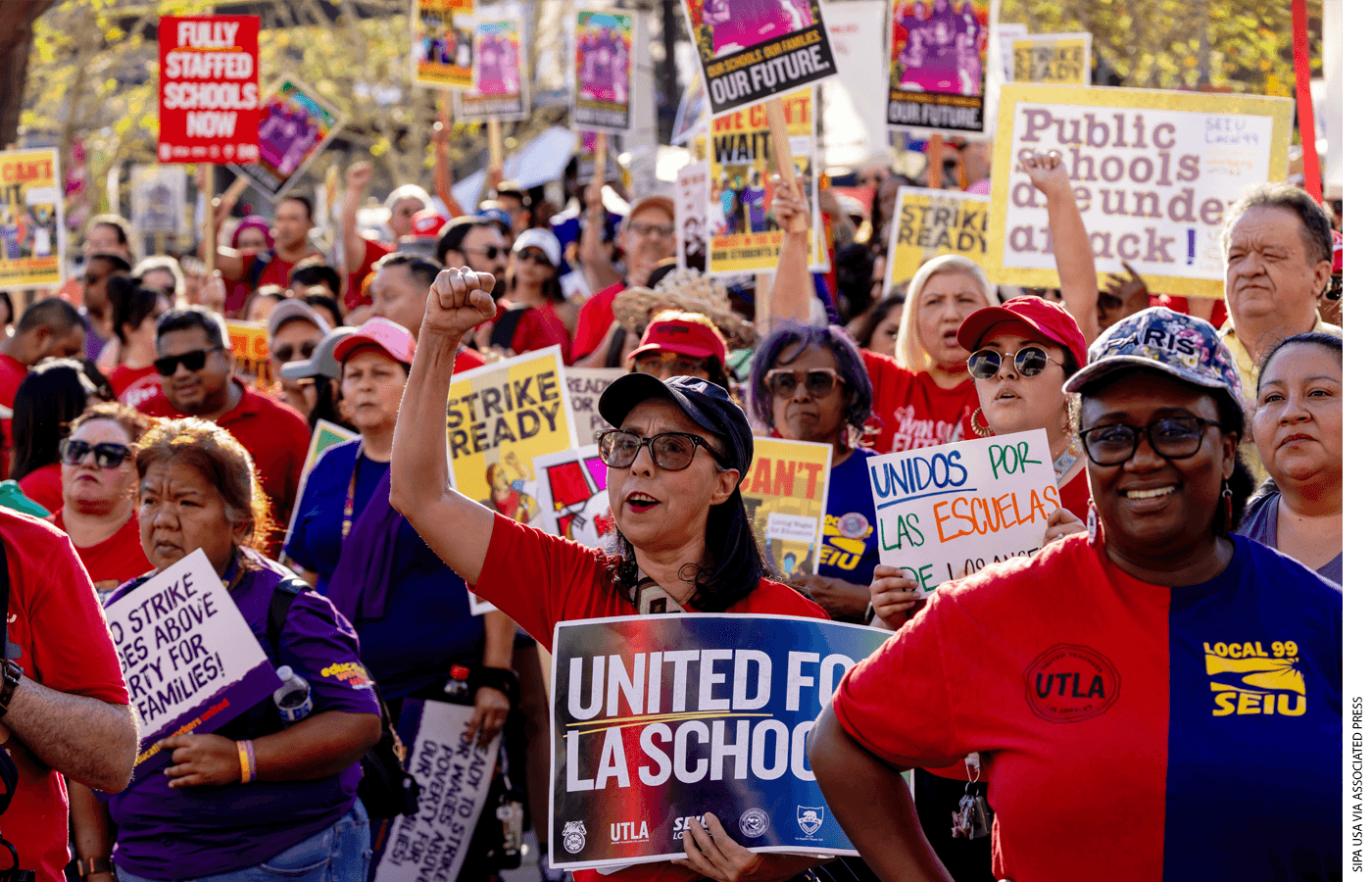
2. Broaden the labor coalition. Teachers unions don’t represent everyone in labor affected by education failure. Far from it. SEIU and other unions represent parents and students, too. Democrats should build a wider labor alliance that reflects both providers and consumers as did parent advocates in Chicago recently in an important school funding fight.
3. Align with parents. Democrats have spent years talking around parents instead of to them—and sometimes worse, treating them as a problem to be managed rather than partners to be respected. Parents care about results, safety, and honesty. They want to know whether their children can read, do math, and graduate prepared for real opportunities. They don’t want jargon, excuses, or process—they want answers.
4. Elevate rank-and-file teachers. Groups like Educators for Excellence and Teach Plus show that classroom teachers are often far more reform-minded than union leadership. They’re already racking up education policy wins where they, rather than formal teacher unions, are leading. Their efforts need support, and their voices need amplification.
5. Professionalize teaching—for real. Every high-status profession eventually modernizes training, compensation, and expectations. That hasn’t happened in teaching. I believe it will—and Democrats should lead that transformation, not resist it. If we succeed here, dramatic change can happen organically, from the ground up, lessening the need for top-down pressure and band-aid solutions to structural challenges.
The Need for A Coordinated Effort
If Democrats are serious about rebuilding credibility on education, isolated reform wins like those listed above are not enough. What’s missing is infrastructure: a durable, party-wide coalition that connects reform-minded elected officials, advocates, researchers, organizers, and parent leaders across states and factions.
Education reform within the Democratic Party currently exists in silos—governors operating independently, mayors fighting local battles, legislators advancing policy without air cover, and advocates working state by state with little coordination. Meanwhile, opponents of reform benefit from national alignment, shared messaging, and institutional muscle.
This imbalance is not ideological—it’s structural.
Progressives are doing a decent job in coalitions resisting the Trump agenda but not so well at providing and advancing a proactive and comprehensive vision for change. While at Democrats for Education Reform in the mid-2000s, I led a reform coalition supporting the Obama education reform agenda—which was heavy on raising standards, fortifying assessments, deploying data, expanding choice, and overhauling low-performing schools—widely known as “Fight Club.” I can tell you that, for reasons that are too complex to go into here, nothing like that exists now.
Democrats can continue defending the system as it is—or they can start fighting in a strategic way for the outcomes families—and voters—actually want. A new education strategy grounded in evidence, innovation, accountability, and real choice isn’t just good policy. It’s smart politics.
It’s also essential for students, for families, for teachers, and for a party that once claimed education as its moral high ground—and should again.
Charles Barone is a senior fellow at the National Parents Union and the former director of policy at Democrats for Education Reform.
The post How Democrats Lost the Plot on Schools—and How to Get It Back appeared first on Education Next.
Source: EducationNext
Please Follow Us:


Please Share:
