
Think Higher Education Has Clear Standards for Academic Freedom? Think Again.
Every week seems to bring a new controversy regarding suspected or confirmed violations of academic freedom. Why are these conflicts so common? We think the answer is at least partly that university leaders and U.S. courts have provided little consistent guidance about what academic freedom does and does not protect. Add to that a growing rejection of free-speech norms, especially among students, and you have a recipe for disaster. We discuss these issues, with links to pivotal court cases and survey research, in the white paper “Academic Freedom” in the AEFP Live Handbook of Education Policy Research.
At first glance, the principle seems simple. Professors should be free to study what they choose and express their views on contentious issues without fear of institutional censorship or retaliation. In practice, however, the boundaries are not always clear, with disciplinary actions levied by university administrators for things faculty have said or done, followed by legal challenges from professors in response.
When courts evaluate free-speech claims, they generally apply a mix of both traditional First Amendment law and professional norms developed over time by organizations such as the American Association of University Professors (AAUP). These court decisions often hinge on factors such as whether the speech relates to teaching or scholarship and the degree of disruption to the classroom or university environment.
Our examination of the legal and research record on academic freedom produced four key findings.
1. Academic freedom has long been a core value of higher education, grounded in the idea that viewpoint diversity and the free exchange of ideas are central to the academy’s truth-seeking mission.
2. Legal disputes about academic freedom often turn on the dividing line between employee conduct, which receives limited protection, and speech, which benefits from extensive protection. Yet these cases have not produced clear answers about the importance or scope of academic freedom.
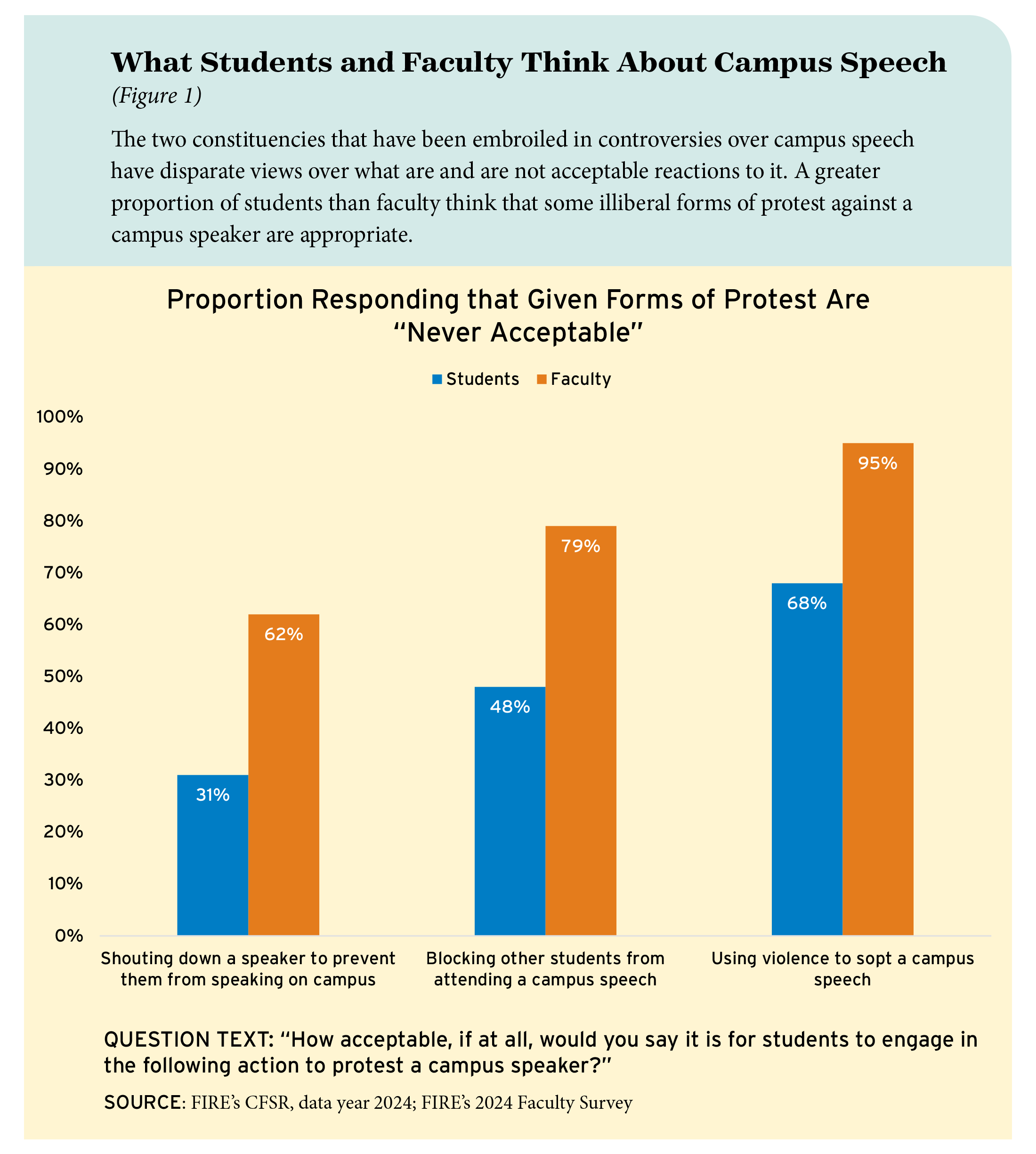
3. Campus surveys indicate that many faculty worry about being punished for the content of their teaching or research. As shown in Figure 1, faculty are much more supportive of the basic principles of academic freedom than students. Only two-thirds of students indicate that it is never acceptable to use violence to stop a controversial speaker from sharing their views. That proportion should be 100 percent.
4. Institutional neutrality is increasingly being promoted as a safeguard for academic freedom. Under this approach, colleges and universities commit themselves to refraining from taking official positions on political or social controversies unless those issues directly affect their educational mission. Universities that do not practice institutional neutrality endanger academic freedom on their campuses by implying there is only one correct view on a controversy, potentially coercing faculty, students, and staff into adopting that view or staying silent. Although more universities are remaining neutral about the controversial issues of the day, relatively few have adopted formal statements on academic freedom, such as the Chicago Principles and the Kalven Report.
EdNext in your inbox
Sign up for the EdNext Weekly newsletter, and stay up to date with the Daily Digest, delivered straight to your inbox.
To better understand and address the challenges of academic freedom and campus free speech, additional surveys of students and faculty are needed. Future research should also endeavor to include other campus populations, such as graduate students and staff. And multiple organizations should replicate and extend the existing survey findings, which to date have largely been conducted by a single organization, the Foundation for Individual Rights and Expression. Research examining how a university’s free expression climate relates to other outcomes such as research output, public trust, and student and staff satisfaction would also deepen our understanding of the topic.
Academic freedom is a simple principle but a complicated practice. To achieve it requires greater clarity from courts and institutions alike about what scholars may say and do. Such guidance would benefit everyone from faculty to administrators to students to the broader public as we engage in that hallmark of academia—free inquiry—to learn more about ourselves and the world we inhabit.
Patrick J. Wolf is a Distinguished Professor of Education Policy at the University of Arkansas. Alex Wolf is the Policy Analyst at EdChoice. Nathan Honeycutt is a Research Fellow and Manager of Polling and Analytics at the Foundation for Individual Rights and Expression.
The post Think Higher Education Has Clear Standards for Academic Freedom? Think Again. appeared first on Education Next.
Source: EducationNext
Please Follow Us:


Please Share:
