

The Classical Learning Test Takes Aim at the SAT–ACT Duopoly

The floodwaters raged. Infuriated by the ceaseless clamor from the crowded city of Shurrupak on the banks of the Euphrates River, the gods had resolved to purge the masses from it. Only a few mortals, tipped off ahead of time, managed to escape in a boat and bear witness.
The ancient Mesopotamian Epic of Gilgamesh is believed to be the first of the many flood myths in literature and religion, including the story of Noah and his ark. It’s also an example of the reading excerpts included on the nation’s fastest-growing college admissions exam.
Like high school students who take the SAT and ACT, those sitting for the Classic Learning Test, or CLT, are challenged to answer multiple-choice questions about passages like this. But what sets it apart is that the CLT is based entirely on classical texts.
This aligns it with a growing classical education movement in charter and Christian schools, in some colleges, and among families who home-school. The CLT has also been discovered by conservative politicians who see it as a lever to re-emphasize the teaching of classical and Western concepts over newer and often controversial ones.
The test “seeks to enhance the way young people are educated” by giving schools and home-schooling families “a fresh incentive to focus on enduring ideas,” according to Classic Learning Initiatives, the for-profit company behind the CLT.
Now the CLT is surging, from an average of about 3,000 tests taken annually to 300,000 last year, according to the company. That’s still fewer than a tenth as many tests as are administered annually by the ACT and SAT. But it’s enough to capture the attention of admissions directors and scholarship providers—which is likely to continue feeding the momentum.
Admissions offices at about 300 colleges and universities have agreed to accept the CLT. Red-state legislators have pushed for it to be considered for admission to their public universities. Defense Secretary Pete Hegseth has ordered service academies to accept it. And legislation sponsored by Republicans in Congress would expand it to federally run tribal colleges and schools on military bases.
None of this is just about a test. The trajectory of the CLT intersects with pivotal trends in politics, religion, standardized assessment, and K–12 and postsecondary education.
Many on the left agree about the value of a classical education—the CLT’s board of advisers includes not only Heritage Foundation President Kevin Roberts and Christopher Rufo, who has worked to outlaw critical race theory, but also progressive activist Cornel West. Yet the test has clearly become a weapon in the culture wars. It’s “one of the more hopeful things happening in the education space,” wrote Colin Redemer, director of education at the conservative Protestant group American Reformer. (Others on the right complain the CLT is actually too “woke” for having sought out classical authors diverse in race and gender.)
What really seems to be motivating supporters of the CLT is the prospect that a new college entrance exam drawing from classic literary and historical texts will push schools to refocus on the Western canon, along with pent-up anger over the long-held standardized testing duopoly of the ACT and SAT parent College Board.
There remain questions—notably, but not solely, raised by College Board—about whether enough is known about the CLT as an assessment tool to trust it. But in addition to support from red-state politicians, there is much that’s working in the new test’s favor.
For instance, while universities and colleges have largely continued their test-optional policies since the end of the pandemic as they struggle to fill seats, the Trump administration has exerted pressure on them to drop consideration of characteristics such as race in admissions and to return to “objective criteria” like the ones standardized test providers and their supporters say they measure.
“The current administration is being increasingly clear that colleges that want to receive federal funding are not going to be able to continue to be test optional,” says Jeremy Wayne Tate, cofounder and president of CLT.
Meanwhile, homeschooling and enrollment in conservative Christian schools are both up, expanding the CLT’s core market. And employers want the kinds of critical thinking skills from prospective hires that advocates of classical education say it teaches.
Graduates of classical education programs “make the best employees, because they actually know how to think,” Tate says.
He and supporters of the CLT and classical learning have unremitting confidence that they’ll prevail.
In that regard, they resemble Utnapishtim, the man who led those few survivors out of Shurrupak in the Gilgamesh epic. He was rewarded by the gods with immortality.
A New Kind of Entry Test
Classic Learning Initiatives marked the 10th anniversary of its Classic Learning Test in October 2025 in the organization’s hometown of Annapolis, Maryland, hosting what its leadership called a retirement party for arch-rival College Board, which is celebrating its 100th. The dress code: 1920s style, with men sporting scally caps, bowties, and pocket watches and women in long dresses. It was a swipe at College Board’s SAT, launched in 1926 as the Scholastic Aptitude Test, which the CLT is determined to dethrone as the nation’s dominant standardized admissions exam by 2040.
These kinds of universal assessments date to a time when students were subjected to separate entry tests by different schools. In the 1930s, elite institutions began using standardized tests in the hope that such “aptitude” tests would help them identify promising candidates from public schools and diverse socioeconomic backgrounds. But as the number of Americans attending college rose and admissions offices relied more heavily on tests—the ACT (which originally stood for American College Testing) came along in 1959—the exams faced scrutiny for favoring wealthier students who attended better-resourced high schools and whose families could afford test prep and to pay to take the tests repeatedly for higher scores.
A few schools gradually stopped requiring the SAT or ACT, and almost all made them optional during the pandemic, when testing centers couldn’t operate. Even since then, with competition ramping up for applicants, nearly 2,100 institutions have continued to make standardized tests optional for admission, according to the organization FairTest, which is critical of these exams.
A small number of mostly selective universities, including seven out of eight of the Ivies, have resumed or announced they will resume requiring standardized tests. But most admissions offices have shifted to emphasizing grade-point averages, class rank, extracurricular activities, and other measures. This, in turn, has led to concern about grade inflation—a development that the testing companies have not coincidentally studied closely and reported. The average GPA rose from 3.27 to 3.38 from 1998 through 2016, according to an analysis led by a College Board researcher, and the proportion of high school students graduating with an A average went from less than 39 percent to nearly half, even as SAT scores fell. A separate ACT report says the average high school GPA increased from 3.17 to 3.36 from 2010 to 2021. These trends have continued since the pandemic, newer research shows, including studies by investigators at the University of Washington Center for Education Data and Research and the Education Policy Institute at the University of North Carolina, Chapel Hill.
These long-running debates continue to play out. Do grades say more about applicants’ abilities than tests do? Do tests benefit the wealthy? Do they predict success in college? Yet another study last year, by scholars at Brown and Dartmouth universities, found that ACT and SAT scores do, in fact, correlate with the academic performance of first-year students at selective colleges.
But test-taking has declined. About two million students in the high school class of 2025 took the SAT, below the more than 2.2 million who did in 2019, the last year before the pandemic; during the same period, the ACT dropped from nearly 1.8 million test-takers to fewer than 1.4 million.
Last year the research arm of the Educational Testing Service, which administers the SAT for College Board, not surprisingly proclaimed that “the future of assessment contains challenges.”
That’s the backdrop against which the Classic Learning Test was launched.
With a bachelor’s degree in secondary education from Louisiana State University and a master’s in religious study from Reformed Theological Seminary, which was founded by conservative Presbyterians, Tate says he was disillusioned when his students at a Brooklyn public school where he worked seemed less interested in the classics than in what they thought they’d need to know to get a good score on the SAT or ACT.
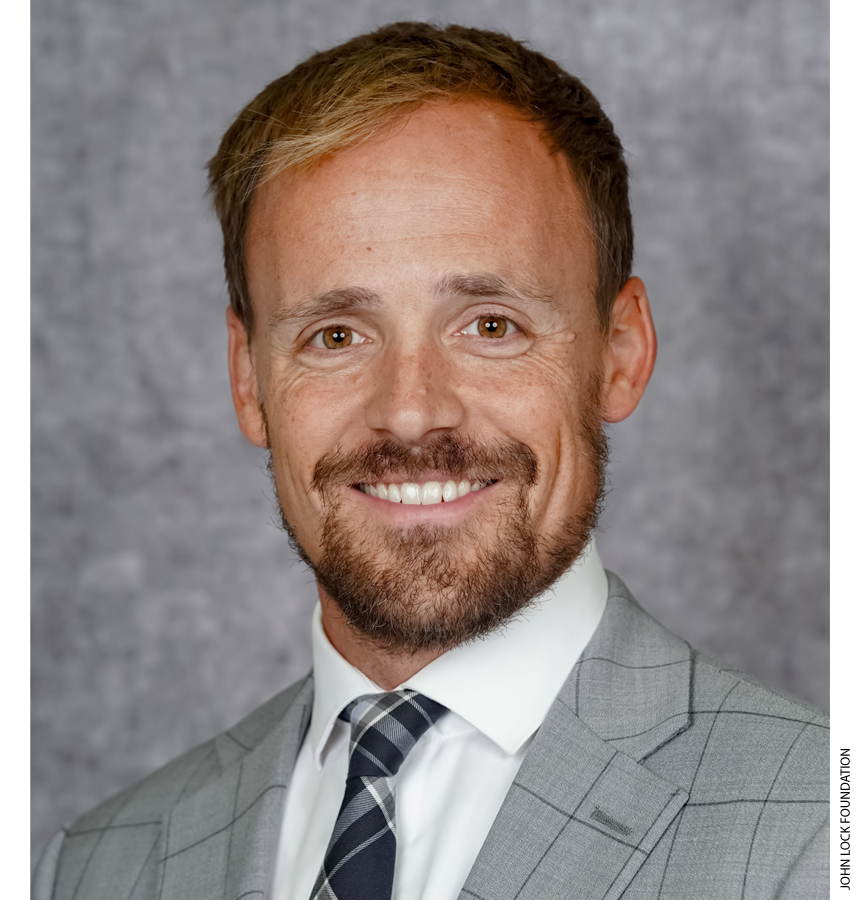
After leaving that job in 2014 to become a college counselor at Mount de Sales Academy, an all-girls Catholic high school outside Baltimore, Tate was again disappointed when not a single student signed up for an introductory philosophy class taught by “a very sweet Dominican nun.” When he asked them why, he says, “the number one answer from students was, ‘Mr. Tate, it’s not on the SAT.’” (Philosophy is also not among the 40 subjects for which students can earn college credits through College Board’s Advanced Placement, or AP, courses.)
He was incredulous, Tate says. “We can’t get our Catholic kids in Catholic schools to take philosophy” because they didn’t see a college admissions advantage. So Tate decided to create his own test to compete against the SAT and ACT. In 2015 he teamed up with David Wagner, a friend since 5th grade and an entrepreneur who had experience with startups, to establish Classic Learning Initiatives and create the Classic Learning Test. (Classic Learning Initiatives is for-profit. College Board is a nonprofit, with revenues of more than $1 billion a year; ACT, which was previously nonprofit, was acquired last year by private equity firm Nexus Capital Management and made for-profit.)
All three tests ask students to read text passages and answer questions about them. But the CLT’s biggest difference is that its readings come from classic literature, science, philosophy, religion, and history, based originally on the “great books” curricula of St. John’s and Thomas Aquinas colleges. Among others, these feature Sophocles, Homer, Confucius, Ovid, Chaucer, Martin Luther, Voltaire, John Milton, and Adam Smith.
Part of his motivation for the CLT, Tate says, derives from what he says he saw in Brooklyn and at Mount de Sales: that the content of college entry tests drives what’s taught in high schools. “If we wanted to change curriculum, we had to start at the test,” he said in a conversation published by the right-leaning education think tank the Thomas B. Fordham Institute.
The CLT would later add 19th- and 20th-century authors and thinkers, including Jane Austen, Sojourner Truth, Karl Marx, Susan B. Anthony, Leo Tolstoy, Oscar Wilde, W. E. B. Du Bois, Mahatma Gandhi, Zora Neale Hurston, George Orwell, Langston Hughes, and Toni Morrison. This would chill the early enthusiasm for the test among some of its conservative backers.
The CLT organization says that, just as with the reading passages in the SAT and ACT, test-takers don’t actually need to have read these texts beforehand, since the multiple-choice questions are based on the information provided in them and are meant to assess students’ ability to understand each piece of writing. Most of the passages are just over 500 words—much longer than those on the SAT, though shorter than some on the ACT.
According to a sample test, these might include an excerpt from St. Teresa of Avila’s The Way of Perfection, first published in 1577, about the vow of poverty. “When I have least, I am the most free from care,” wrote the Carmelite nun, mystic, and religious reformer. Or something from Book IX of Plato’s The Republic (“How, without rules, is the tyrannical man formed out of the democratical”), paired with Federalist No. 63, from The Federalist Papers, about the need for a senate—a “temperate and respectable body of citizens, in order to check the misguided career and to suspend the blow meditated by the people against themselves.”
The grammar and writing section might draw from texts such as Booker T. Washington’s autobiography, Up from Slavery, or Albert Camus’s Nobel Prize lecture.
Passages in the reading and writing section of the SAT, by comparison, are much shorter—roughly 50 to 100 words, judging from a practice test—and sometimes include a graph or table. They may be about space flight or how predatory beetles decimated non-native trees; or they may be passages from Walt Whitman’s Leaves of Grass, Jack London’s The Call of the Wild, or the short story “Out There,” by Provincetown Players cofounder Susan Glaspell; or a complete poem by Black American author Angelina Weld Grimké.
Students who take the ACT might be asked to answer questions about a 300-word description of a Brazilian chef who promotes sustainable local ingredients or 200 words about Hrosvitha, one of Europe’s earliest-known women playwrights, who lived in the 10th century, according to a sample of that test; there are also passages exceeding 800 words, including one about hip-hop culture in New York and excerpts from Ann Beattie’s short story “Janus” and Michael Pollan’s book The Botany of Desire: A Plant’s-Eye View of the World.
Like the other tests, the CLT also has a math section covering algebra, geometry, and mathematical reasoning, but—unlike the ACT and SAT—not statistics. Also, students taking the CLT are not allowed to use calculators as they can on the other tests. College Board asserts that 25 percent of the math questions on the CLT, based on a published sample test, were below high school grade level.
All three exams cost about the same—$68 for the ACT and SAT and $69 for the CLT. The CLT is offered 15 times a year compared to seven for the ACT and eight for the SAT. The ACT takes just under three hours, the SAT about two hours and 15 minutes, and the CLT two hours and 20 minutes.
Some of the nation’s 3.9 million annual high school graduates likely take more than one of these tests, though neither the testing companies nor the National Association for College Admission Counseling say they track this data. A CLT spokesperson says it’s likely that many of its test-takers also take one of the other exams, since the ACT and SAT are still accepted by more colleges and universities. Particularly ambitious college-bound students required by their states to take the ACT or SAT in school might also take one of the other tests if they think it might improve their odds of acceptance at elite institutions, according to private college consultants, who sometimes recommend this practice but more commonly say it isn’t necessary.
The CLT is administered both in person at participating schools and remotely, in part to accommodate the many home-schooled students who take it. About a quarter of participating students take the test remotely, a CLT spokesman says. They can start at any time during a 12-hour window on scheduled administration dates. Although they and their screens are audio- and videorecorded for review later, the approach has drawn criticism from education policy analyst James Murphy, who worries about the potential for cheating, since students are allowed to have scratch paper and—says Murphy—it seems implausible that proctors could review the tens of thousands of hours of recorded video and audio.
Test experts also question how much influence college entry tests really have on what gets taught in high schools. “If kids would actually read those books, I’m all for that,” says Harry Feder, executive director of FairTest, who is also a former teacher. But Feder notes that students who take the CLT don’t have to read the books because the information they need to answer questions is right there on the test. It’s “a canard,” he says, that tests like these affect what’s happening in classrooms.
But CLT has tapped into a growing movement among schools and parents that are already teaching what it tests.

A Foothold Among Homeschoolers and Christian Schools
Among the fastest-growing sectors in U.S. education are homeschooling, classical charter schools, and Christian schools.
Nearly 1.8 million students are home-schooled, up 21 percent since before the pandemic, according to the U.S. Department of Education. The top reason parents give for homeschooling is their dissatisfaction with the other options available to them. More than half want to give their kids religious instruction.
When schools went remote during Covid, these parents could directly observe what their children were and weren’t learning, says Jessica Hooten Wilson, chair of the great books program at Pepperdine University, who founded and chaired a private classical Christian school for K–12 students and who sits on the CLT’s advisory board. “They became tired of the shallow pools of education,” Wilson says.
The number of conservative Christian and other religious schools has also increased since the start of the pandemic. It’s up by 8 percent, a notable rise considering that the number of K–12 private schools overall, including Catholic schools, fell during that time. Nearly 800,000 students now attend conservative Christian schools.
These have become the principal market for the CLT. Forty percent of its test-takers attend private schools and 37 percent are home-schooled, the company says. Growth in Christian education and homeschooling would propel the CLT, Wagner told the Association of Biblical Higher Education, because the other standardized tests have “an agenda which is often antithetical to our worldview,” leaving classically educated students “disadvantaged in their college aspirations.”
People who want to study classic texts “are marginalized everywhere, except in the CLT,” agrees Zena Hitz, author of Lost in Thought: The Hidden Pleasures of an Intellectual Life and a tutor in the great books program at St. John’s College. Yet people from across the political spectrum are craving this kind of comparatively traditional education, Hitz says.
“Our political handlers are not aiming at a high level of human understanding. They’re aiming at what’s lowest and most base in us. So part of this is a desire to escape from that, and to reconnect with stuff that really matters and can help you understand the world,” she says.
High schools and colleges have become more like vocational schools, Hitz and others say, at a time when the labor market most needs critical thinkers like the kind they say classical learning produces. “If we want people who shape the world, they have to have a serious liberal arts education,” Hitz says. “There’s absolutely no substitute for it.” Adds Wilson, at Pepperdine: “The ones who know how to think, how to articulate, how to innovate—they will triumph over the specialists.”
How well the CLT syncs with homeschooling was the subject of a study at Houston Christian University, which found that home-schooled students scored much higher on the test than students from other educational backgrounds. That’s because many home-schooling parents choose the kinds of classical works excerpted in the CLT’s reading sections, says the study’s author, Lisa Treleaven. “They like the structure it provides when you’re wanting for a student to be a good writer and speaker and make connections among a lot of subjects.”
Admissions directors at many of the mostly small, religiously affiliated colleges that have signed on to accept the CLT are hoping to attract students from this growing pool at a time of otherwise shrinking college-going. That’s partly because such students are likely to be good fits and partly because the schools need all the applicants they can get. Many buy the names of test-takers from the CLT, which, like the SAT and ACT, sells them to college and university admissions offices.
“We recognize the value of the test itself and the community that takes advantage of it,” says Randy Spade, interim vice president for enrollment management at Ashland University. “These were students we wanted to go after,” says Mark Ciolli, vice president of enrollment management at The Catholic University. “Students when they come to Catholic are introduced to the Catholic intellectual tradition, the great books. They tend to adjust a little better if they’ve been exposed to that tradition in high school.” Joel Bauman, senior vice president for enrollment management at Duquesne University, says, “We assume that students who sit for the test mirror the intellectual curiosity and interdisciplinary thinking” emphasized on his campus.
Still, in a mark of the CLT’s newcomer status, some schools that accept the test, including DePauw University and St. Olaf College, say no applicant has ever submitted it. In Louisiana, where students can now use CLT scores to qualify for a state merit scholarship, only one has so far done it, a Board of Regents spokesperson says.
Nor is there universal agreement about whether the test fulfills its principal purpose: predicting the success in college of the applicants who take it.

Questions of Quality
Standardized tests periodically produce “concordances” of student scores so admissions officers can compare the rigor of the various tests. Even the competing ACT and SAT collaborate on these concordances.
The CLT’s only concordance so far, produced in 2023, gets poor grades from independent scholars.
To show that it was comparable to the SAT, the CLT analyzed a sample of about 5,000 test-takers, compared to 589,753 in the most recent concordance by the SAT and ACT. The CLT group, comprising mostly home-schooled students and those from private schools, was not representative of U.S. students generally, notes Audrey Amrein-Beardsley, a professor of education policy at Arizona State University who studies education measurement and evaluation methods. Scores that were outliers weren’t counted. The CLT asked some students in the concordance to self-report their SAT scores, which were not independently verified. And several schools in Florida that administered the test to students for the purpose of the study were paid, which Amrein-Beardsley says taints the results.
The CLT’s concordance “fails to meet the quality expectations for a legitimate, high-stakes linking project, namely with representative sampling, rigorous peer review, transparent data documentation, and independent replication,” Amrein-Beardsley says.
The test has gotten better reviews from some institutions that say they vetted it before agreeing to accept it. Grove City College released a study in October 2025 indicating that CLT scores reliably predicted first-year grades, for example. Hillsdale College scrutinized test questions, compared scores with those from the SAT and ACT, and administered the CLT to 38 freshmen, says senior director of admissions Zachary Miller, before concluding “it provides a solid indication of a student’s readiness for college-level work and potential fit with Hillsdale’s classical course of study, when read together with the rest of the file.”
But when the Iowa Board of Regents considered approving the CLT for public universities in that state, it too determined that the sample of home-schooled and private school students in the CLT’s concordance wasn’t representative of applicants to those institutions and didn’t meet industry standards like the ones produced by College Board and the ACT.
Years of experience is needed to make dependable conclusions about assessment tests, says Joanna Gorin, vice president of academic measurement for the ACT. “We have decades of evidence with a very stable result,” Gorin says about her company’s test. “It’s not just about did we get some evidence to suggest this is predictive, but did we get to a point where this prediction is consistent.”
The CLT hasn’t been around for decades. “We’re young,” Tate concedes. “We know we’re young. We can’t act like we’ve got 30 years of data.” But he says the ACT and College Board are fighting to protect the powerful duopoly that they’ve enjoyed. “They have a situation right now where they each have one competitor and they’d like to keep it that way. They don’t want another one.”
College Board did not respond to repeated requests to talk about the CLT. Under pressure from its client universities, however, it produced a brief in 2024 pronouncing that the Classic Learning Test “is not predictive of college performance or success and has no relationship to student outcomes.”
The CLT’s momentum has only picked up since then, however—thanks principally to politics.
An Expanding Reach
“The gold standard.” That’s what Defense Secretary Pete Hegseth called the CLT, in a post on X, before ordering the nation’s service academies to accept it. That decision was “a victory for merit,” responded Republican U.S. Senator Jim Banks, who had pushed for it. The new test, Banks told Politico, measures “knowledge of the great ideas that built our nation.”
The CLT has irrefutably become a weapon in the battle over what some conservatives deride as unpatriotic or divisive teaching within such disciplines as American history and particularly the role of race and gender in that teaching. “We see classical learning as a very exciting return to the basics,” right-wing Oklahoma Superintendent of Public Instruction Ryan Walters said when calling for the CLT to be administered in that state’s public schools, before he resigned in September 2025.
By far, the CLT has received its biggest boost in Florida, whose Republican governor, Ron DeSantis, banned an AP course in African American studies for allegedly including content the state does not allow to be taught there, including critical race theory. “Who elected them?” DeSantis said of College Board. “Are there other people that provide services?”
The board of governors of the state’s university system—the second largest in the country and the biggest to still require standardized tests for admission—swiftly answered that question by agreeing to accept the CLT alongside the ACT and the SAT. This came over the objections of the faculty representative, University of Florida business professor Amanda Phalin, who said the CLT lacked “empirical evidence that it is of the same quality” as the other two tests.
Within a year, the number of CLT test-takers in Florida shot up to 120,000, while the number sitting for the SAT dropped by 11 percent between 2023–24 and 2024–25 and the proportion of high school students taking the SAT fell from 95 percent to 87 percent.
Other red states have followed Florida’s lead. Arkansas in March 2025 required state-funded universities to accept the CLT. Bills have been introduced in Tennessee and West Virginia to do the same thing. In Texas, the Higher Education Coordinating Board was directed to study the possibility of having public universities accept the CLT in admissions. Oklahoma and Wyoming ordered that the test be considered for state scholarship programs. Indiana’s governor signed a bill in March requiring the state’s public universities to accept it for admission. In Congress, a bill cosponsored by Republican U.S. Representative Lauren Boebert, the Promoting Classical Learning Act, would require the test to also be accepted by tribal colleges and federally run schools.
EdNext in your inbox
Sign up for the EdNext Weekly newsletter, and stay up to date with the Daily Digest, delivered straight to your inbox.
Although the CLT welcomed these decisions as rejections of what it called “modern pedagogical fads,” the organization has tried to thread a generally apolitical needle. In Tate’s prolific social media presence, he has posted or reposted conservative denunciations of teachers unions, Bernie Sanders, the U.S. Department of Education, and critical race theory. But he says classical education has value precisely because it’s not political. It makes young people “far less likely to fall for the political gimmicks of the present,” Tate says, “regardless of whether those gimmicks come from one side or the other.”
It’s not CLT but College Board that is politicizing assessments, Tate wrote in The Federalist, by “removing any of the so-called dead white males of the past, leaving students with little more to wade through than dry scientific texts or reading samples from prominent left-wing politicians.”
Tate “wants everyone to be invited,” says Wilson, of Pepperdine and the CLT board. “It’s a nonpartisan enterprise. We’re doing it best when we say classical education is for everyone.”
That idea has drawn criticism from a surprising source: the right, which has erupted in a spirited debate—fittingly citing Socrates and Aristotle, in arguments sprinkled with Greek and Latin—about whether the CLT itself has “gone woke,” by including modern authors and thinkers of diverse backgrounds in the “author bank” from which its reading excerpts come.
“The classical education movement has caught the wokeness bug,” began one such attack in the magazine The American Conservative. What it called the diversity efforts of the CLT marked the beginning of “a war set to end in the conquest of the classical education movement by liberalism,” it said. “The moment you agree to play the left’s game, they secure the victory.”
Others say they “really dislike the stripping of ‘Christian’ from classical Christian education,” as Benjamin Merkle, the president of New Saint Andres College and another member of the CLT board, put it in a blog post. “Once you delete ‘Christian,’ you really have a hard time explaining why we are focused on the Western intellectual tradition.”
Tate is conciliatory. “Friendly disagreement within our community stimulates debate and keeps the movement vigorous,” he wrote in response to these critiques.
In fact, he says, these differences provide all the more reason to support the kind of learning his test is trying to encourage. Part of what it means to be an educated person, he says, “is that you can engage an idea without having a meltdown, and that ideas are not dangerous and offensive.”
To be college ready, Tate says, “if you’re a conservative, you need to be able to read a progressive. If you’re progressive, you need to be able to read a conservative.”
Jon Marcus is senior higher education reporter at the Hechinger Report. He writes about higher education for the New York Times, the Washington Post, NPR, and others.
Suggested citation format:
Marcus, J. (2026). “The Classical Learning Test Takes Aim at the SAT–ACT Duopoly: The upstart assessment is making inroads in the college admissions game.” Education Next, 26(1), 26 March 2026.
The post The Classical Learning Test Takes Aim at the SAT–ACT Duopoly appeared first on Education Next.
Source: EducationNext
Please Follow Us:


Please Share:
